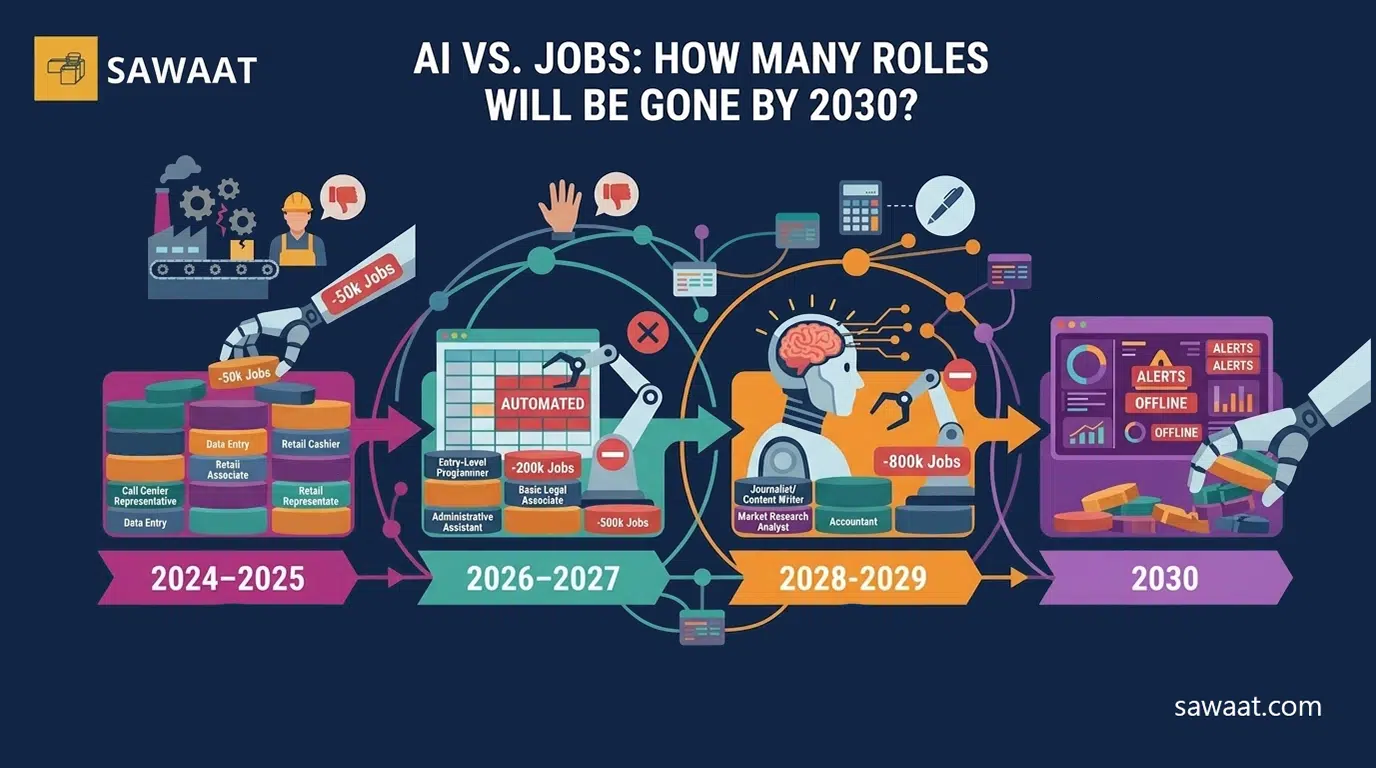
Let’s be real, the question isn’t whether AI will take jobs. It already is. The real question is how many, how fast, and honestly, whether your industry is next.
I’ve seen the headlines swing wildly in both directions. One week it’s “AI will destroy the workforce.” The next it’s “AI will create more jobs than it kills.” Both camps have data to back them up, which makes this genuinely tricky to navigate. So, let’s cut through the noise and look at what we actually know.
The short version? Millions of roles are going away. But the longer story is more complicated and a lot more interesting.
The Numbers (And Why They’re Scary)
The World Economic Forum put out numbers that genuinely made people stop scrolling, around 85 million jobs could be displaced by automation and AI by 2026. Not 2050. Not a distant future. 2026. And that’s considered a conservative estimate by some researchers.
McKinsey’s research paints an even broader picture. Their analysts estimate somewhere between 400 million and 800 million workers could be displaced globally by 2030. Goldman Sachs threw their hat in with a projection that AI could replace the equivalent of 300 million full-time jobs. And here in the US, roughly 25% of all current work tasks could theoretically be automated using technology that already exists today.
So which jobs are we actually talking about? Mostly the ones built around repetition. Data entry. Telemarketing. Basic bookkeeping. Customer service queues. Truck routes. Assembly linework. These aren’t predictions about some far-off robotic future, the automation of these roles is already well underway in most major industries.
Okay, But It’s Not All Doom
Here’s where it gets interesting. The same WEF report that flagged 85 million displaced jobs also noted that around 97 million new roles could emerge by 2025. New roles. Not replacements, genuinely new categories of work that didn’t exist in any meaningful form a decade ago.
The catch? These new roles require a completely different skill set. And right now, there aren’t nearly enough people with those skills to meet demand. That gap is massive. Companies in healthcare, finance, logistics, and retail are all scrambling to hire data engineers, AI specialists, and machine learning engineers, and most of them are coming up short.
That’s why things like AI staffing and data staffing have gone from niche concepts to boardroom priorities almost overnight. The businesses moving fastest on AI transformation aren’t necessarily those with the best technology, they’re the ones who figured out the talent problem first.
The Industries Feeling It Most Right Now
Finance was one of the earliest sectors to go all-in on automation. Fraud detection, credit risk modeling, compliance reporting,these used to require entire teams. Now they run algorithms. Banks have been quietly shrinking their back-office headcount for years while simultaneously fighting over the same small pool of quant developers and data scientists.
Healthcare is trickier. AI diagnostic tools are genuinely impressive, and the administrative side of medicine is getting heavily automated. But the human side, patient care, judgment calls, bedside manner, that’s not going anywhere soon. What IS changing is the volume of data those clinicians need to make sense of, which is creating serious demand for health data infrastructure.
Retail has quietly been one of the biggest transformation stories. Inventory management, demand forecasting, personalized recommendations most of them are AI-driven now. The cashier’s conversation is well-documented, but what gets less attention is how much of the supply chain planning behind the scenes has already been automated.
And then there’s marketing. Generative AI has walked into content creation, ad targeting, and SEO with a sledgehammer. Teams that used to take six people to run now run on two people and a stack of AI tools. That’s not a future scenario, it’s happening at companies right now.
The Talent Problem Nobody Talks About Enough
There’s a strange irony at the center of all this. AI is cutting jobs in some places while creating a desperate shortage of skilled workers in others. LinkedIn’s data showed AI and Machine Learning Specialist as one of the fastest-growing job categories globally, with a 74% annual growth rate. The demand is there. The supply just isn’t keeping up.
This is where Data Engineering Staffing becomes genuinely critical. Think about what sits underneath every AI product a company builds, data pipelines, cloud infrastructure, real-time processing systems. None of that works without skilled data engineers who know how to architect and maintain it. You can buy the best AI software in the world, but if your data foundation is a mess, it doesn’t matter.
Solid data staffing is what separates companies that talk about being data-driven from ones that are. Getting the right mix of analysts, scientists, and engineers in place isn’t a one-time hiring push, it’s an ongoing strategy, especially as AI tools evolve, and the skills required to shift with them.
Traditional recruiting timelines don’t work for this. When you need a senior ML engineer or a cloud data architect, you can’t wait four months and hope someone good applies. The companies winning the talent game are the ones working with staffing partners who specialize in this space and have networks that general recruiters simply don’t.
What Should Workers Actually Do?
If you’re worried about your job, the most useful thing I can tell you is this: stop waiting to see what happens. The professionals who will do well through 2030 aren’t necessarily the most technical ones, they’re the ones who figured out how to work alongside AI tools rather than compete with them.
Learning Python or SQL doesn’t mean you’re becoming an engineer. It means you’re becoming someone who can have an intelligent conversation with engineers, spot opportunities for automation in your own workflow, and bring actual value to AI projects that need domain expertise. That combination human judgment plus technical literacy is genuinely hard to replace.
Roles like AI prompt specialists, automation consultants, data analysts, and AI ethics reviewers are growing fast. None of them existed as formal job titles five years ago. Five years from now, there will be more of them, not fewer.
Where Does That Leave Us?
AI is going to displace a lot of jobs by 2030. That’s not speculation anymore it’s a trajectory. But the story doesn’t end at displacement. It ends with whoever adapts fastest coming ahead, whether that’s individual workers building new skills or companies that got serious about their AI staffing strategy before their competitors did.
The companies I’ve watched navigate this well share one thing in common: they stopped treating data and AI talent as a hiring checkbox and started treating it as a competitive advantage. That shift in thinking changes everything about how they recruit, retain, and build their teams.
AI versus jobs is the framing everyone uses. But the more accurate picture is AI plus the right people and right now, finding those people is the hardest part of the whole equation.