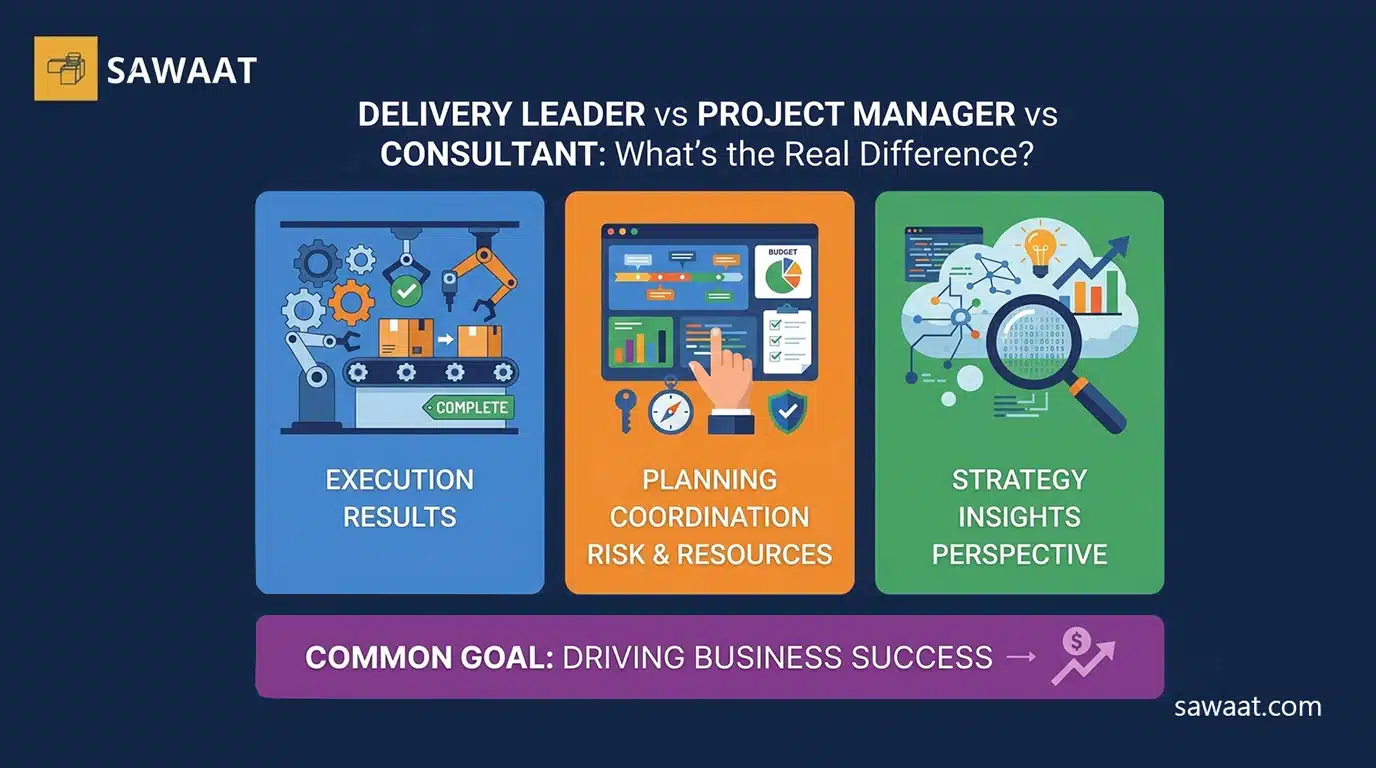
In the modern tech and corporate landscape, job titles often blur together. If you walk into any major digital transformation initiative or data implementation strategy, you will likely hear titles like Delivery Leader, Project Manager, and Consultant thrown around interchangeably.
People try to explain them as if they are just different seniority levels of the same job, but that is not technically correct. While all three roles exist to help an organization achieve its goals, they operate with fundamentally different mandates, perspectives, and metrics for success.
When businesses invest in Enterprise Delivery Management or large-scale technological shifts, choosing the right type of leader can make the difference between a project that merely finishes on time and one that actually transforms the business.
To understand the real difference, we need to break down the core function of each role.
The Project Manager: The Execution Engine
The Project Manager (PM) is the master of the “how” and the “when.” Their primary responsibility is to take a defined scope of work and ensure it is executed efficiently.
Project Managers operate within the iron triangle of constraints: scope, time, and budget. They are the tactical force that keeps the trains running on time. In the realm of Data project Management, for example, a PM doesn’t necessarily decide which machine learning model to build, but they ensure the data engineers, data scientists, and analysts are hitting their sprint milestones, mitigating blockers, and staying within budget.
Key Characteristics of a Project Manager:
- Focuses on tactical execution, timelines, and resource allocation.
- Measures success by on-time, on-budget delivery against a predefined scope.
- Manages daily stand-ups, risk registers, and sprint planning.
- Acts as a shield for the technical team to keep them focused on their tasks.
The Consultant: The Strategic Advisor
If the Project Manager is focused on the “how,” the Consultant is focused on the “why” and the “what.” Consultants are typically brought in to solve a highly specific, complex business problem that the organization lacks the internal expertise to solve itself.
They are the strategists and diagnosticians. A consultant will analyze the current state of a business, identify gaps, and propose a roadmap or framework. However, they are often disconnected from the long-term, gritty execution of that advice. They drop in, provide high-value strategic direction, and often exit once the roadmap is handed over.
Key Characteristics of a Consultant:
- Focuses on strategy, problem-solving, and specialized domain expertise.
- Measures success by the quality of insights, frameworks, and actionable recommendations provided.
- Operates largely at the executive or stakeholder level, gathering requirements and presenting findings.
- Generally works on a shorter-term, advisory basis rather than long-term implementation.
The Delivery Leader: The Accountability Owner
The Delivery Leader sits at the intersection of strategy and execution. They are responsible not just for getting the project done, but for ensuring the project actually delivers the intended business value.
While a PM asks, “Are we on track?”, the Delivery Leader asks, “Is what we are building actually going to solve the client’s problem?” They own the overarching relationship with the business stakeholders and are accountable for the end-to-end health of an account or program. This role requires heavy Data Driven Leadership using real-time metrics, financial forecasting, and team performance data to make strategic pivots mid-flight.
If a project is technically delivered on time but fails to generate ROI or user adoption, a Project Manager might still consider it a success based on their specific metrics. A Delivery Leader would consider it a failure.
Key Characteristics of a Delivery Leader:
- Focuses on overall business value, client satisfaction, and financial health of the portfolio.
- Measures success by ROI, product adoption, and long-term client retention.
- Bridges the gap between high-level executive strategy and ground-level technical execution.
- Handles escalations, commercial negotiations, and high-stakes stakeholder management.
A Quick Comparison
To make the distinctions clearer, here is a snapshot of how the three roles compare across their primary focus areas:
- Primary Focus: The Project Manager focuses on task execution and timelines. The Consultant focuses on strategy and specialized advice. The Delivery Leader focuses on business value and account health.
- The Core Question: The Project Manager asks, “Are we on schedule?” The Consultant asks, “What is the best approach?” The Delivery Leader asks, “Are we driving real impact?”
- Success Metric: The Project Manager is measured by on-time, on-budget delivery. The Consultant is measured by the quality of the solution or roadmap. The Delivery Leader is measured by ROI, profitability, and client success.
- Engagement Phase: The Project Manager is highly involved during active execution. The Consultant is heavily involved in upfront strategy and diagnostics. The Delivery Leader owns the end-to-end journey from strategy through post-launch.
Why Organizations Need All Three
It is rare that these roles compete rather they form a critical ecosystem for complex initiatives.
Imagine a massive enterprise migrating its legacy infrastructure to a modern cloud data platform. The Consultant comes in first to assess the legacy systems, evaluate cloud providers, and design the overarching migration strategy. The Project Manager then steps in to break that massive strategy into a 12-month timeline, assigning specific migration tasks to engineering pods and tracking daily progress. Finally, the Delivery Leader oversees the entire lifecycle, ensuring the consultant’s strategy remains viable, the PM has the resources they need, and the C-suite is confident that the final platform will actually reduce their operational costs.
The debate isn’t about which role is better it is about deploying the right skillset at the right time. When you understand the unique value each brings, you can stop fighting operational fires and start building scalable, sustainable success.