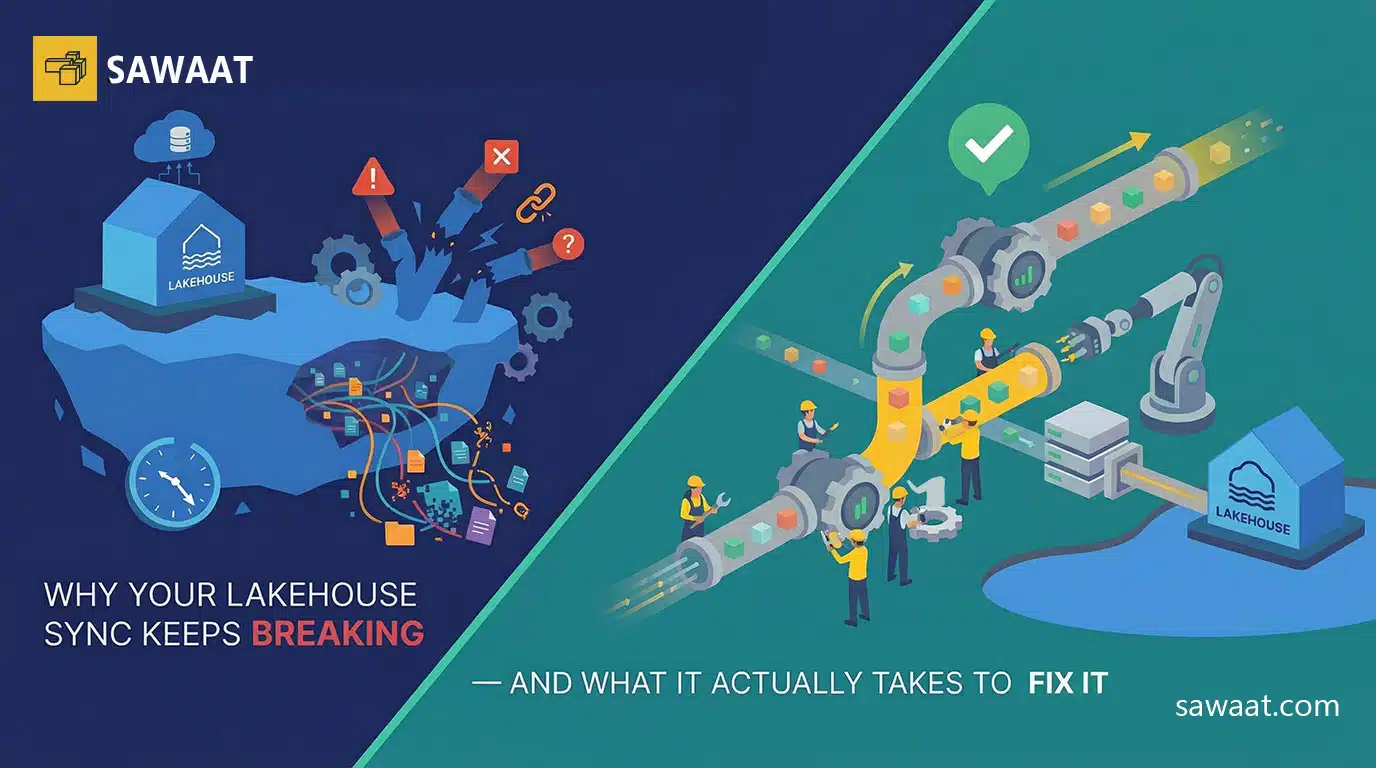
Nobody builds a data platform expecting it to fall apart. But here’s what usually happens.
A pipeline delay shows up on Tuesday. Someone investigates, applies a quick fix, and moves on. Two weeks later, a table of refreshing fails — different symptoms, but weirdly like energy. Then a report goes stale. Then an object just… disappears. Each incident gets treated as its own thing, gets resolved in isolation, and gets quietly logged (if it’s logged at all). And before long, the team is spending more time keeping the lights on than actually building anything.
I’ve seen this more times than I can count. The frustrating part isn’t that these problems exist — it’s that they were almost entirely predictable.
First Thing to Understand: It’s Never Just One Problem
When teams come to us saying “our Lakehouse sync keeps breaking,” the instinct — totally understandable — is to go looking for the bug. The one thing is causing everything. Fix that, and you’re done.
That’s not how it works.
Lakehouse sync failures almost always come from several directions at once, overlapping in ways that make them genuinely hard to diagnose. The three we run into most often:
Gold-to-silver sync breaks down.
The Medallion architecture — Bronze, Silver, Gold — only works if data actually flows reliably between those layers. When the Gold layer stops getting clean data from Silver (schema drift, write conflicts, resource exhaustion — pick up your poison), analysts start seeing numbers that are wrong, or old, or just… off in a way they can’t pin down. That’s when you start getting the “I don’t trust the dashboard anymore” conversations, which are honestly some of the hardest conversations to come back from.
SQL endpoint failures.
Most business users never touch raw Lakehouse storage. They’re working through SQL endpoints — the layer that BI tools and dashboards connect to. When sync between the Lakehouse and those endpoints breaks, the damage is immediate. Reports fail, or worse; they don’t fail — they just show stale data with the same visual authority as fresh data. Stakeholders don’t know the difference. They just know the numbers are wrong, and suddenly the whole data team’s credibility is on the line.
Metadata backlogs nobody noticed until it was too late.
This one is sneaky. Metadata operations — tracking schema changes, partition info, table stats — get treated like background noise, things that’ll sort themselves out. And then they don’t. A growing backlog doesn’t announce itself with a big error. It shows up as gradually slower queries, sync jobs that take a little longer each day, delays that seem random but aren’t. By the time someone starts investigating, the backlog is enormous.
What We Actually See When We Look Under the Hood
There’s a pattern that shows up across almost every Lakehouse implementation we’ve worked with, regardless of company size or tech stack.
The team is always reacting. Incidents surface because a user complained, or a report went red — not because monitoring caught it first. When we ask about historical incidents, the same failure types keep appearing, but nobody recognized them as a pattern because there was never a system for tracking and classifying them. Each one got treated as new. And perhaps most tellingly, the people responsible for day-to-day platform health — the ops team — often haven’t been given the tools or documentation to handle these situations confidently when they happen at 2am.
The result is a platform that’s permanently in firefighting mode. The team isn’t bad. Technology isn’t bad. The operational foundation isn’t there yet.
Four Failures We See in Production (With What Actually Fixes Them)
Rather than staying abstract, here’s what these problems look like when they’re real:
V2 checkpoint misconfiguration.
Delta tables configured for V2 checkpointing in environments that don’t fully support it will fail unpredictably — sometimes immediately, sometimes weeks later. The fix is reverting the Delta table properties to classic checkpointing behavior and re-validating the sync pipeline before declaring it resolved.
Orphaned references removed from shortcuts.
When someone removes a Lakehouse shortcut — a reference to an external data location — without cleaning up everything pointing to it, sync jobs start hitting objects they can’t resolve. The process hangs. The fix is tracking those orphaned references in the metadata layer, removing them cleanly, and re-triggering the affected workflows.
Internal Error 18.
This one usually signals resource contention at the storage or compute layer. Running OPTIMIZE on the affected Delta tables is the right first move — it compacts small files and often resolves it. If not, it’s a vendor escalation; there’s underlying infrastructure involved that isn’t accessible from your side.
Metadata refreshed backlog.
Once identified, this needs active triage. Not everything in the queue is equally important — you need to prioritize the metadata updates that unblock the most critical downstream sync processes and work through the backlog systematically rather than waiting for it to self-resolve.
The Architectural Problem Behind All of This
A lot of Lakehouse sync architectures share a design flaw that only becomes obvious at scale: the entire sync runs as one big batch job.
When that’s the setup, one failing table — even a minor one — can block everything else from completing. A problem in an obscure, low-priority table holds up the tables that matter. There’s no isolation, no independence, no way to let healthy parts of the system proceed while you deal with the broken one.
The better approach is decomposing sync into parallel, table-level operations that run independently. Failures remain contained. Healthy tables finish on schedule. Your blast radius for any given incident shrinks dramatically. This isn’t a performance optimization — it’s the architectural foundation that makes everything else possible.
What “Mature” Actually Looks Like
Reaching a point where Lakehouse sync is genuinely stable — not just “stable for now” — requires getting four things right:
Consistent error handling across every pipeline.
Not ad hoc, not each team doing it their own way. Uniform error classification, retry logic with sensible backoff, dead-letter queues for failed records, alerting that notifies the right person at the right threshold. Every pipeline, every sync job, same framework.
Real observability.
You can’t fix what you can’t see, but more importantly, you can’t prevent what you can’t see. Tracking sync job duration, failure rates, metadata queue depth, and resource utilization in real time — with dashboards that surface anomalies early — is what separates teams that prevent outages from teams that respond to them.
Governance that actually covers sync.
Schema change management. Access controls on critical Delta tables. Change management processes that stop well-meaning modifications from silently breaking pipelines downstream. Governance isn’t just a compliance checkbox; in this context, it’s a stability mechanism.
Operational readiness.
Runbooks for known failure scenarios. Operators who’ve been trained on the platform actually understand it. Defined escalation paths for novel issues. Regular reviews to catch emerging risks before they become incidents. A technically excellent platform operated by a team without these things will eventually break and keep breaking.
The Honest Summary
Technology doesn’t create reliability by itself. We’ve worked with teams running sophisticated, well-architected Lakehouse platforms that still spent enormous amounts of engineering time on incidents — because the operational discipline wasn’t there.
The most important shift isn’t architectural. It’s moving from reactive to proactive. From treating every incident as new to building the pattern of recognition that catches problems before they escalate. From hoping the system stays stable to building a platform and a team that makes it stable.
If your sync issues feel random, they’re not. Every unexplained delay, every stale report; every failed refresh is a signal — that the platform hasn’t yet reached the maturity required to hold up reliably at scale.
Fixing individual incidents keeps you afloat. Building the right foundation is what actually gets you out.
At Sawaat, that’s what we focus on — not just building architectures that look right on paper, but ones that hold up in production, month after month. Fault-tolerant designs, standardized error handling, real observability, and operational readiness that make your team genuinely self-sufficient. If this sounds familiar, let’s talk.
Want a step-by-step breakdown to diagnose and fix these issues in production? Read our Lakehouse Sync Troubleshooting Guide
If Lakehouse sync issues are slowing you down, Sawaat helps you fix them at the root—so your platform stays reliable in production.